





This post contains affiliate links. If you use these links to buy something, we may earn a small commission. Thank you!
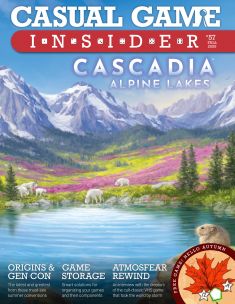
After scouring the halls and taking in the sights and sounds (and floods) at Gen Con 2026, we humbly present to you rapid reviews of some of the hottest games of the show. To read our full coverage of all the happenings of Gen Con, check out our Fall 2026 issue of Casual Game Insider.

The Op Games | 1-4 players | 30-45 minutes | ages 10+
The landscape of tile puzzle games is a crowded one. Few board games fully extend their elbows out to carve out a niche, and by its soft, floral presentation it’s unlikely Evenglow would seem poised to fully extend its pointed extremities. But that, my friends, is because those spiky appendages are aimed at your cranium.
Evenglow has all the thinky brain burning and analysis paralysis of the genre’s best, but in a cozy and beautiful package. It’s a simple enough premise: the first player draws a card with four of the five florae available and decides which direction to play the card. The two images closest to them will be the two tiles they choose, and the other two are for the other players to grab and place. However, placement is not some mere act of adjacency on one area, but a choice of one in each of the magical sunlight and moonlight sides. These two halves are mirror images, and placement of each tile must also be mirrored by placing them in the same numbered hex. This is the true puzzle, because each flora has its own scoring conditions, and within those scoring conditions are groupings that also earn potions for extra points and means to bend the rules.
The rest is merely normalized play. Play continues until all the cards are revealed, tiles are placed, and points are tallied from tile placements and any acquired potions. Though unassuming by its packaging, the foam tiles and simple elegance of Jason Katzwinkel’s game lend themselves to a greater presentation. There are optimal strategies, but there is no optimal gameplay to be found – especially when each player has the agency to determine not only what tiles they’ll place, but what others must claim and place. The solo experience is a bit cozier, but even the most chill players may find themselves lifting their elbows off the table and feeling a need to make their presence known by the end of Evenglow.

CGE | 1-4 players | 30-120 minutes | ages 12+
The buzz around Drillers at Gen Con was that it presented itself as an easier, more casual version of massive CGE hit Lost Ruins of Arnak. Unlike that exploration themed beast, Drillers loses the tracks and tight resource management for a streamlined deck builder that only asks players to drill down, grab minerals, and turn those cubes and former blockades into money and victory points.
Money allows players to improve their drilling machine (having more fuel to do actions and more space to store minerals) or streamline their starting deck by removing cards and buying better ones. Minerals are how money is made but also provide points at the end of the game — and a mechanism by which the end of the game can be sped up. Points are accumulated by not only gathering these resources, but also drilling into the sides of each floor or drilling further down the mine.
I understand the comparisons to the meatier LRoA, but Drillers is something far more despite being an easier teach and play. Gamers startled by the 120-minute playtime will be happy to know that even at 4 players, it’s unlikely a game of Drillers is going to last longer than 90 minutes even during its first plays. Drillers is very much a learn-as-you-play game, with mechanics familiar to any beginning or casual gamer. Spend fuel to gain actions from your cards to drill or move between floors, or gain fuel from playing cards to delay the need to resurface.
Drillers is generous with its choices but also provides a solid amount of tension between players as they race to go deeper into the mine for more valuable minerals and tiles (AKA points), while also adding in a slight racing element as some players may be employing a strategy to quickly end the game and cause some players to lose points by being stuck deep in the mines when the game ends. It plays as kindly or as mean as your gaming group, but neither method will limit what can be experienced and explored.

Allplay | 1 player | 10-20 minutes | ages 10+
You play as the owner of a cozy fairy tale establishment with a cavalcade of eccentric guests in an often-shifting inn where demands must be met for points. This solo experience is both comforting in its theme and story, walking the player through varying scenarios with different guests — each with contrasting or complimentary demands — with simplicity in execution but complexity in achieving the goals of each scenario.
Shuffle the deck of 20 cards (removing any number outlined by the parameters of the scenario), gather the list of guests who need accommodations and place their avatars in a cloth bag, and then draw two cards and two guest chits from the bag, playing one card with its window side and the other with its ivy-only side. Different colors of ivy have different ivy patterns, which is vital to scoring points, as well, because the bigger your ivy patches, the more points you will earn. Once the cards are placed, choose one of the guests and place them on the window card, being mindful of their scoring requirements. After all cards are placed, and all but one guest is placed, points are totaled and the player will determine if they have advanced to the next scenario. Completing goals and reaching high scores can also provide doors, which provide a bit of extra strategy and relief.
Enchanted Ivy can be played outside the story content as well, but it is highly recommended to play through it and enjoy the light campaign elements and fun story involved. A highly engaging, brain melting, but very rewarding solo experience that will make your family curious to play it too.

Flatout Games | 1-4 players | 30-45 minutes | ages 10+
Award-winning designer Randy Flynn and Flatout return to the fruits of their success with this standalone continuation of the singularly named Cascadia. Alpine Lakes has the familiar tile and animal drafting mechanics from the original, as well as the same mechanics of optimizing the spatial puzzle of creating land masses, prioritizing animal placements based on rotating parameters for points, and breaking the rules with the nature tiles when necessary. However, Alpine Lakes simplifies the land masses to three but ramps up the complexity by introducing tile stacking where the titular lakes are scored the higher they are in the landscape you create. Rather than a sprawling natural paradise of hiking and animal watching, Alpine Lakes now asks you to ascend higher and breathe more rarified air.
And gasping for a few extra breaths will occur in every game, as the analysis paralysis is quite gripping in its own hyperventilating cozy way. When you claim a tile and animal pairing from the shared market, where do you place them, why are you making that choice, and will it be the most fruitful move? Factor in additional scoring cards that also change how each grouping of terrain is scored and that smoke rising won’t be from an imagined campfire on a lovely patch of Pacific Northwest greenery but coming from your brain working out all the permutations. Yet, Alpine Lakes is not a stressful game; it just asks more of its players. Much like Knitting Circle turned Flatout original Calico on its head, so too does Alpine Lakes for its namesake. A different puzzle with a familiar feeling but it’s up to you to decide if this climb is worth the view at the end (spoiler: it is).