





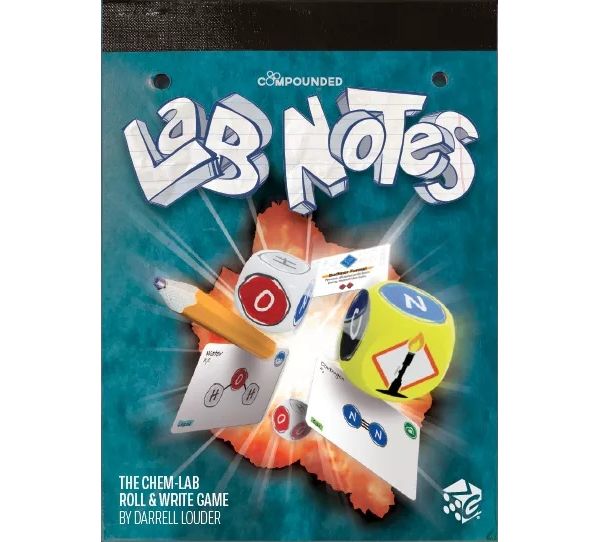
Create chemical compounds, check your lab notes, and avoid lab fires in this science-y roll-and-write.
Published by Greater Than Games, Lab Notes is a dice game designed for 2-5 players, with a 40-minute game time.
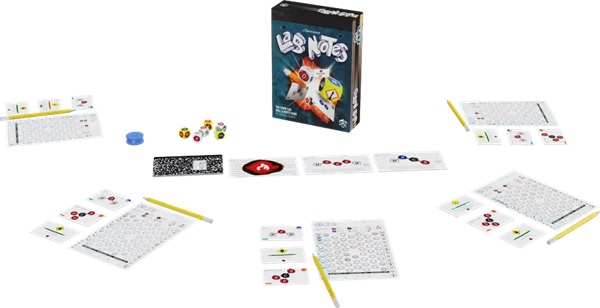
Each player takes a player sheet that shows a bunch of circles. Each turn, the active player rolls dice equal to the number of players, plus one. Each player then takes a turn drafting one of the dice, with the final die acting as the communal die. Dice may show one of four chemical elements. Each player will write down their drafted die’s element into any one circle on their player sheet, then repeat this action with the communal element. A player may choose to trash an element instead of writing it down, but there is a limit on how many times this can be done.
When writing an element in a circle, a player may choose to draw a connecting bonding line between it and an adjacent circle. Hydrogen can connect to one other element, oxygen to two, nitrogen to three, and carbon to four. These lines can be to the same element or to different elements.
After a player has finished adding elements to his sheet that round, he may circle any completed compounds – this is a set of elements that are connected to each other, and all the elements within that compound have used their maximum number of connections. To calculate how many points a completed compound is worth, the player counts how many sets of connecting lines there are. A set of one is worth a single point, a set of two is worth three points, and a set of three is worth six points (you are never allowed to connect four lines between two carbon elements, so there are never sets of four). The combined total is how many points it is worth.
Players can also create specific compounds. At the start of the game, each player is dealt the same tool cards, which start on their inactive side. By creating the compounds listed on these tool cards, players not only earn the points those compounds are worth, but also flip over the tool cards to their active sides. Tools have helpful abilities, but players may only use their tools a certain number of times. There are also special compound cards forming a display in the center of the table. Players may complete these to earn extra tool uses as well as bonus points. At the end of the round, when one of these compounds has been completed, it is discarded and a new one is drawn. Lab fire cards sometimes get drawn this way.
When a lab fire occurs, each player must cross out two circles on their player sheet. Sometimes a die result will be a Bunsen burner instead of an element. If a player drafts this, he may write any one element into a circle on his sheet and cross out any one other space. If no one drafts it, a lab fire occurs and everyone must cross out two spaces.
The game ends once a player’s sheet is full and they have no spaces left for new elements. If players have any elements that are not connected to other elements, these are crossed out. Any incomplete compounds have their points calculated, losing one point for each connecting line an element could have had but did not use. Each player also loses two points for each crossed-out space. The player with the most points wins the game.
Lab Notes is a fairly accessible roll-and-write with a theme that sets it apart. The theme and mechanics also complement each other nicely and work well together. Watching the player sheets slowly fill up, with more and more compounds getting circled, is an enjoyable journey. The different tools are quite helpful, and the fact that you can play with different combinations each game offers some nice variety.
There’s very minimal player interaction, outside of occasionally drafting a die another player was eyeing. The Bunsen burner is a very clever mechanic, balancing one lab fire and one compound or everyone suffering with two lab fires.
We really enjoyed that you could just make tons of different combinations of compounds and weren’t restricted to just those in the display, although those earned bonus points. It opened up the game and made it feel more like you were experimenting.
The fact that the game comes with everything you need to play is greatly appreciated, especially the pencils and sharpener. We liked the components and general look of the game, and the player sheets are nicely laid out and easy to read. However, there are some blatant mistakes in the graphics included in the rulebook and some core concepts in the rules are left vague and hard to decipher.
Each compound card also lists a little bit of information about the listed compound, which is a nice touch — although some of them seemed to be assuming a level of understanding of the subject that we didn’t possess. But it is likely to appeal to people interested in this theme to begin with.
This isn’t a perfect roll-and-write, but it is an enjoyable one, and there are enough things here to set it apart. It’s a satisfying game with something different to offer.
Pros: Science theme, Bunsen burner mechanic, ability to create different compounds not just those in the display
Cons: Issues with the rule-book, minimal player interaction
Disclosure: we received a complimentary review copy of this game.


The "Buy from Amazon.com" button above is an affiliate link. If you purchase using this link, we may earn a commission.