





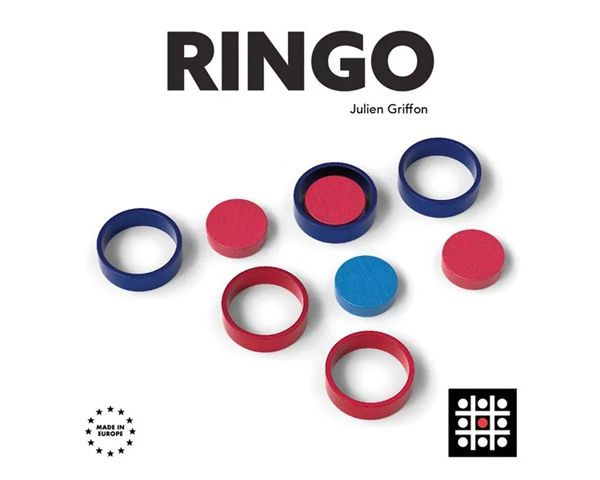
Place a disc and move a ring, as you try to line up four of a kind while blocking your opponent.
Published by Steffen Spiele and Helvetiq, Ringo is a two-player abstract game with a 15-minute play time.
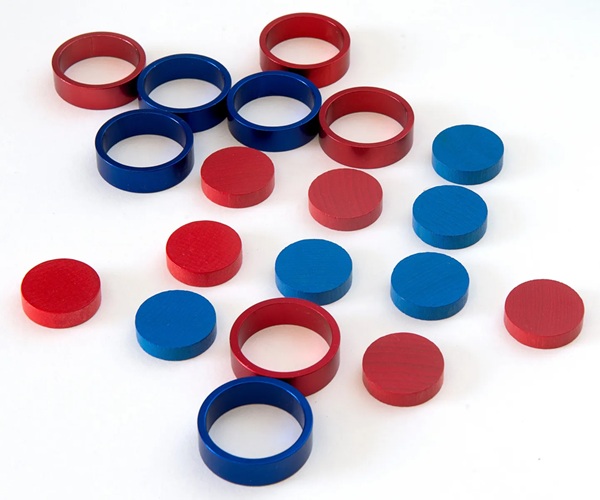
One player is red and one is blue. There are four red rings and four blue rings, which are placed in a three-by-three grid, with the center empty. Each player takes eight discs in their player color.
On a player’s turn, he places one of his discs inside a ring of any color. He then picks up that ring and places it on any empty space, adjacent to any other ring on the table (it cannot go on top of a disc). When a player runs out of discs, he instead takes one of his previously-played discs and places it in a new location. He cannot select one that would cause any pieces to become disconnected.
The first player to get either four discs or four rings of their own color in a straight line (horizontally, vertically, or diagonally) wins the game.
Ringo is a nice, compact little game that feels like a cross between Tic-Tac-Toe and Connect 4, while increasing the strategy to both and making the choices trickier without complicating the rules.
It’s surprisingly layered, with a variety of ways players can work towards creating their rows of four. Early on it feels simple enough to block one another, but once you have to start picking up discs from off the table, while keeping everything connected, and only placing rings down next to rings that are already on the board, it gets harder to maneuver your plans against your opponent’s.
It’s also a game that plays quite quickly. If you want to play something fast over lunch, this is a solid option. It doesn’t take up too much room, so it could also be played at a restaurant table, and is light for packing. The components are also quite nice, with the discs a light wood, and the rings a solid metal that are fun to play with.
Gameplay can get a bit repetitive, so you’re unlikely to want to spend a full evening with this one, but if you only have a short window of time to get a game in, and you’re a fan of abstract games, Ringo is a solid choice.
Pros: Good components, portable, fast, simple to learn
Cons: Can be repetitive
Disclosure: we received a complimentary review copy of this game.



The "Buy from Amazon.com" button above is an affiliate link. If you purchase using this link, we may earn a commission.