





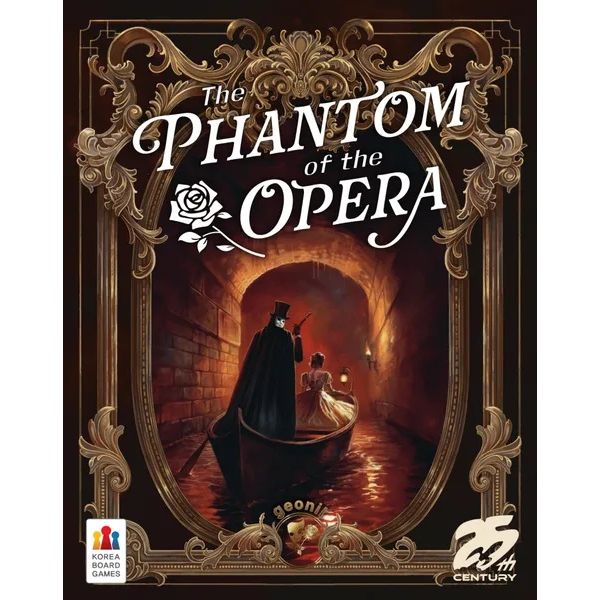
Go head-to-head in this two-player trick-taking card game as the Phantom attempts to compose one final song, and Christine must try to stop him.
Originally released in Japan, 25th Century Games now has released an English language edition of The Phantom of the Opera.
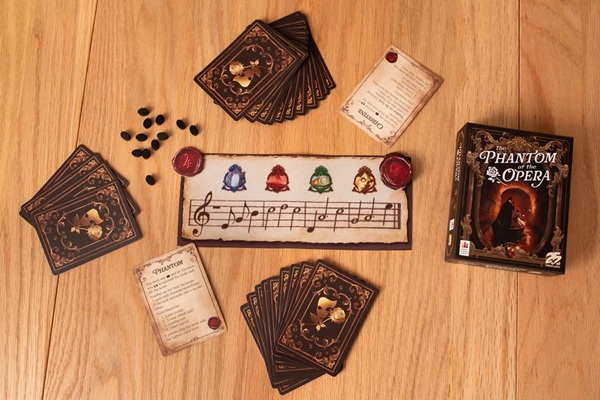
One player takes on the role of the Phantom and one player takes on the role of Christine. You choose to play one of the four music sheets and place it in the center of the table. The deck of 24 cards is shuffled, ten cards are dealt to each player, and the remaining four are set aside for that round. The game is played over two rounds.
The Phantom wins if he completes all 12 notes on the music sheet. Christine wins if it is not completed by the end of the second round. The Phantom starts the first round, and Christine starts the second round.
At the start of the round, each player passes one card to the other player. However, the numbers on both passed cards are checked, and the starting player chooses one number to be the seal number (a token is used to help players remember what the seal number is for that round).
This is a trick-taking game. Each round, the winner of the last trick plays a card from their hand, and the other player must follow suit if able. If the other player cannot follow suit, they may play any other card in their hand. There are four suits, with cards numbered 1-6, and the gold suit is the trump suit. However, the players are playing through the music sheet left to right. The music sheet is divided into four sections, and depending on which section the players are currently in, one of the four suits is also the super trump, which beats the regular trump suit.
There are 12 notes on the music sheet that the Phantom is attempting to fill in to win the game. Players are always on the leftmost unfilled note. There are black notes and white notes. When players are on a black note, the Phantom gets to fill in the note if he wins the trick. If it is a white note, he fills it in if he loses the trick. So, depending on the type of note players are currently on, they either are trying to win the trick or to lose it.
If either player plays a card whose number matches that round’s seal number, both players immediately exchange two cards from their hands. Also, if the Phantom succeeds on that trick, he gets to fill in two notes on the music sheet, while if he fails, one of his filled notes becomes unfilled again. Each round lasts for ten tricks.
A two-player trick-taking game can be hard to come by, but The Phantom of the Opera does an excellent job of filling that niche. It’s not just about winning every trick or losing every trick. It’s about knowing which ones you have to win and which ones you have to lose, and planning your hand as the super trump evolves and players are forced to pass cards.
It’s a clever game where you have to keep multiple factors in your head as you plan which cards to play and win. The changing goal from trick to trick is very interesting, as players constantly have to save different cards for different situations. Both roles play fairly similarly, but the differing win condition brings unique challenges. The Phantom is trying to complete the notes while Christine is just trying to run out the clock.
It’s an aesthetically pretty game, with lovely artwork, although we didn’t love the quality of the cards. The theme also works well with the game, and using the musical sheets to track which tricks players are trying to win and which they’re trying to lose is aesthetically lovely and also allows for variation between games as there are four music sheets to play with.
This is a unique and very clever trick-taker, that feels different from other games in the genre. There’s a lot of replayability as you dive into the best strategies, while the rules themselves remain fairly simple. If you’ve played trick-takers in the past, you’re going to pick up the core mechanics here fairly quickly, but mastering the game is going to take plenty of time. Recommended!
Pros: Immersive theme, changing rules for who succeeds from trick to trick, great artwork
Cons: Card quality
Disclosure: we received a complimentary review copy of this game.



The "Buy from Amazon.com" button above is an affiliate link. If you purchase using this link, we may earn a commission.