






Can you take the trick when you can’t see your own cards? This trick-taking game will leave you guessing with every card you play.
Published by IELLO, Luz is a 30-minute card game, designed for 3-5 players.
10 cards are dealt out to each player, with the remaining 10 cards set off to the side, face-down. Cards have a value of 1-12. Each player takes the cards and organizes them by color, and then within those colors, by number lowest to highest. Each player then passes that hand to the person on their left. A player then takes his new cards and holds them face-out so that he cannot see their values, but other players can. Both sides of the cards do show what color they are, however.
Luz is a trick-taking game. At the start of each round, players look at everyone else’s cards and then bet how many tricks they think they will take. A player bids that number by taking bet beads equal to his bid. He may also choose to take one safety bead.
After everyone has bet, the round starts. Gameplay follows fairly standard trick-taking rules. A player must play according to the color of the first card played into the trick (the leading color) if he has it. The gold suit is the trump suit. The highest trump card wins the trick, and if no trump is played, then the highest card of the leading color wins. The player who wins the trick then plays the first card of the next trick.
However, a player may use his safety bead to steal a trick that another player was about to win.
A player cannot check the number of any card he is about to play. He chooses a card and plays it. The only information he has is its color, if it is a higher or lower card than the other cards in his hand of that same color, and what cards are in his opponents’ hands.
At the end of the round, after all tricks have been played, players check their bids. If a player claimed a safety bid at the start, he wins his bid if he won tricks equal to his bid or one over. If a player did not claim a safety bid, he wins double the points. Players win more points for completing their bid based on what round number it is. If a player did not make his bid, he loses five points for each trick over or under his bid. The game ends after four rounds, and the person with the highest score wins.
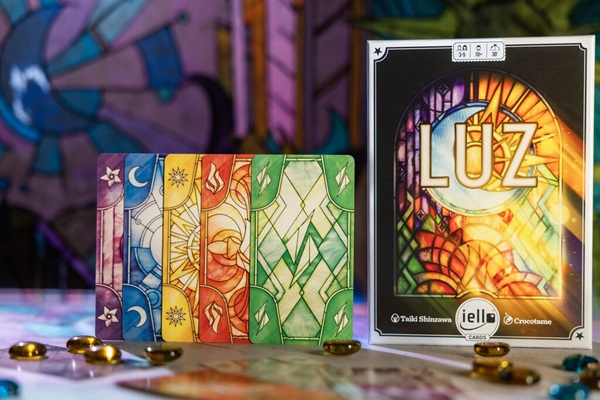
Luz blends trick-taking with deduction. Players must feel out what numbers are likely in their hands, which in turn affects how they will lead into tricks and respond to other players’ card choices. But, since 10 cards are always removed from the deal, no one ever has all the answers. You might have the 12 in your hand. Or it might have been removed from the round.
The push-your-luck element to the bidding also works well. You can take the safety bead, and even use it to claim a trick, but you might want the chance at the bigger score. This also serves as a solid catch-up mechanic that doesn’t feel punishing to the person in the lead. If someone is behind, they can forego the safety bead in an attempt to jump ahead. Also, no one is ever so securely in the lead that they’re in for a guaranteed win by the final round. This is because players don’t score points based on the number of tricks, but if they got their bid correct, and the penalty for a really bad round can be significant.
Luz is also a beautiful game. The cards have gorgeous artwork, the beads add an elegance to the betting, and there’s even a score pad included, which is always a nice, appreciated touch.
If you’re a player who likes a little more casual approach to trick-taking, Luz fits the bill nicely. It’s a clever, enjoyable game, but the element of uncertainty makes it feel slightly less intense than other classic trick-takers. You can’t know everything. You can seldom be certain, but each round has a solid escalation as players get a better idea of what’s in their hands.
Luz is best at its higher player counts of 4 or 5 players, with more cards spread around the table. It’s a game that brings something new to a well-loved genre. It’s enjoyable and nicely designed, with a good pace to its gameplay. Recommended!
Pros: Components, bidding system, scores can easily change up to the last round
Cons: Not at its best at three players
Disclosure: we received a complimentary review copy of this game.



The "Buy from Amazon.com" button above is an affiliate link. If you purchase using this link, we may earn a commission.