




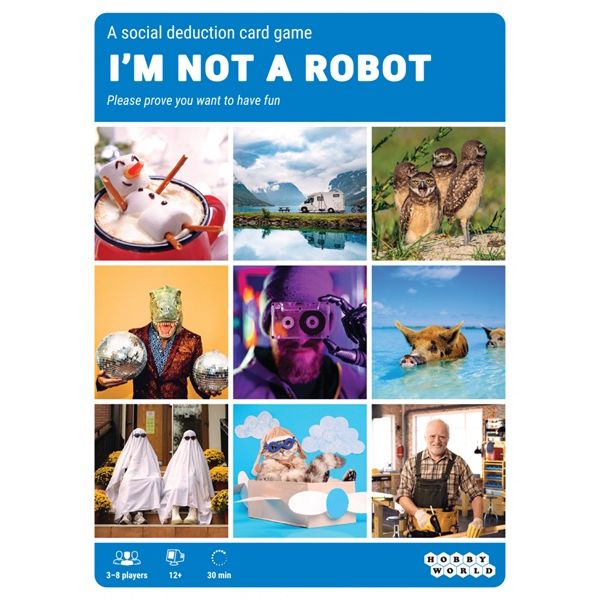
Are you a robot who can hide your true identity from the humans? Or a human trying to hunt the robot? Maybe there is no robot and you’re just being paranoid about nothing!
Published by Hobby World, I’m Not a Robot is a 30-minute game designed for 3-8 players.
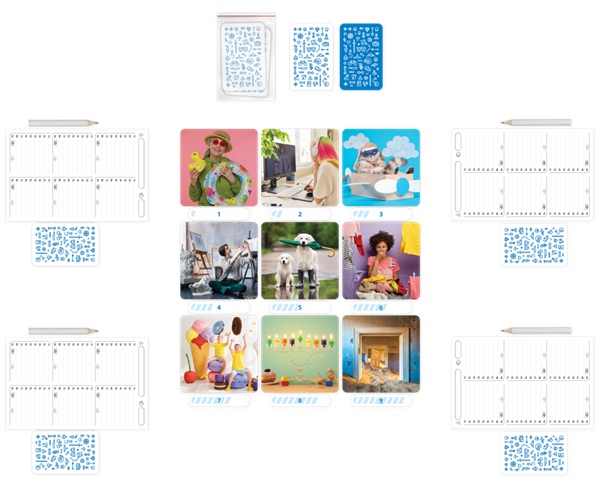
There are nine bags of role cards. Each bag will have human role cards that all show the same number, one blue answer card that will also show that number, and a robot card that has the same back as the human role cards.
Each round, one of the role bags is taken, the answer card is set aside face-down, and each player is dealt a role card. Players check their cards. They will discover if they are a robot or a human, and if they are human, they will see which card in the nine-by-nine grid is the correct image. The robot just learns that he is a robot. One additional role card is dealt face-down next to the answer card. This is the server card. It could end up being the robot card, meaning that no player is actually the robot. The human players are trying to figure out where the robot card is.
Each player, during the round, must say a single word that they associate with the correct image. They do not have to go in a particular order. Each player has a sheet on which they write down each player’s word, as well as the order in which they were said. The robot player obviously does not know what the correct image is, but must try to base his word off of what other people are saying. He is also trying to be subtle about his turn order.
After everyone has given a word, the robot player may guess what the image is. If he guesses correctly, he automatically wins the round; otherwise, the humans win. If the robot does not reveal himself and attempt to guess, the game moves onto the discussion phase. Each player explains why they came up with their association word, and they make their explanations in the same order that they announced their words. Players may then discuss who they think is the robot. Finally, each player simultaneously writes down their guess — who they believe is the robot or if they believe the server card is the robot. Everyone then reveals their votes. The player who got the most votes reveals his role. If it’s human, the robot wins. If it’s robot, the humans win.
A human player scores one point if the humans win and/or one point if he voted against the robot (he gets this point even if the robot won). The robot gets three points if he guessed the image correctly or two points if he did not guess the image, but did not win the majority of the votes.
The game is played over six rounds, with new image cards and role cards being dealt out each round. The player with the most points wins the game.
I’m Not a Robot is a fun take on the hidden traitor party game genre. It doesn’t bring a lot of new ideas to the table, but it brings things together in a satisfying way. The robot player is given interesting ways to hide himself, such as keeping the associations down to a single word. It’s also fun, as the robot, to figure out where in turn order you want to give your association word, and to figure out how you can use that to hide.
There’s a fun, weird range of pictures used on the cards, which gives the game a unique flavor. There’s also a lot of them included, with 144 unique images in the game. Since you’re going to use nine at a time, that’s a lot of different combinations and replay value.
The initial setup is a little confusing, stacking the correct human cards together, and the description in the rulebook is a little hard to understand, but you only have to do this once. The rulebook is also very vague on how long the decision period should last. This section can really overstay its welcome in these kinds of games, so we enjoyed it more when we put a time limit on it.
I’m Not a Robot reminded us of Spyfall, and that’s not surprising after realizing they’re from the same designer. It’s not an unfavorable comparison, either. A few wrinkles have been ironed out from that one, and the robot player felt like he had more of a chance to stay hidden. The possibility of not having a robot is also a nice design decision that adds more doubt and confusion to the mix. This was a fun social deduction party game, that’s light and clever and doesn’t get too bogged down with rules.
Pros: One word clue system creates interesting deduction, unique look to the game
Cons: There are several other games in this genre, first-time setup is confusing
Disclosure: we received a complimentary review copy of this game.